Our namesake

Alan Turing

The man who proved that hidden patterns, decoded with precision and intelligence, can change the world. We named our company after him because we believe the same.

Alan Turing
Princeton, 1936
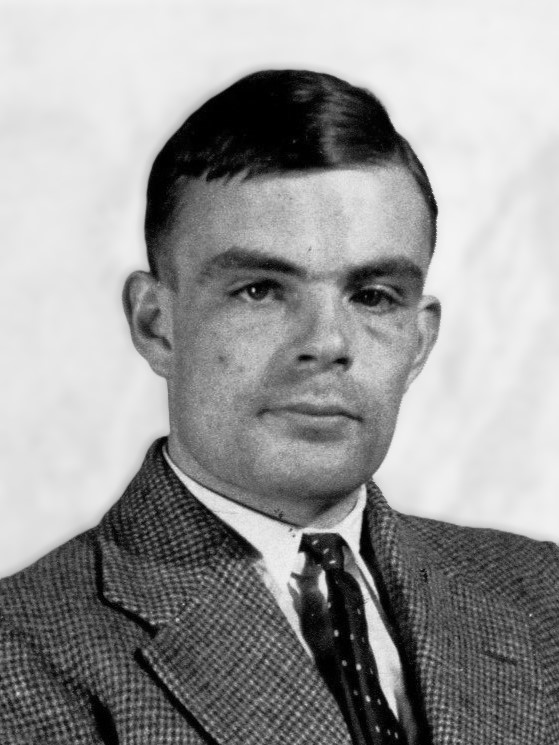
Alan Turing at Princeton University, 1936
Alan Turing · Princeton · 1936

A life of hidden work made visible

June 23, 1912 – June 7, 1954
1936

He invented the concept of computation

Before computers existed, Turing published a paper describing a theoretical machine that could solve any problem expressible in logical steps. He did not build software. He conceived the idea that a machine could follow rules to decode meaning. Every computer ever built traces its lineage to that single paper.

1939 – 1945

He cracked the unbreakable code

Nazi Germany's Enigma machine encrypted military communications in a cipher considered mathematically impossible to break, with billions of possible settings changed daily. Turing led the team at Bletchley Park that built the Bombe: a machine that found the hidden signal inside the noise. Historians estimate his work shortened World War II by two years and saved over fourteen million lives.

1950

He asked: can a machine think?

In a paper titled "Computing Machinery and Intelligence," Turing proposed what became known as the Turing Test, a framework for evaluating whether a machine's intelligence is indistinguishable from a human's. He laid the philosophical foundation for artificial intelligence decades before the field existed.

1952 – 1954

He was failed by the system he saved

Turing was prosecuted by the British government for his sexuality and subjected to chemical castration. He died in 1954 at the age of 41, a man who saved millions and was recognized by almost none of them. He received a formal posthumous pardon from the British Crown only in 2013. His story is a permanent reminder that the most important work is often done invisibly, and that the institutions meant to protect us sometimes fail us instead.

He proved that a system built to be unreadable can be read. We are not solving anything as important. We are applying the same idea to a smaller cipher, and one that no one designed to be unreadable.

"We can only see a short distance ahead, but we can see plenty there that needs to be done."

Alan Turing, 1950

There is plenty here that needs doing. Talk to us.